2027 Scion tC
The 2027 Toyota Scion tC is a compact car produced by Toyota under its Scion brand. As the spiritual successor to the Toyota Celica, the 2027 Scion tC two-door coupe with a liftback design quickly became the brand’s best-selling model, accounting for approximately 40% of all Scion sales. Initially launched with a 161-horsepower, 2.4-liter engine, it was later upgraded to a 180-horsepower, 2.5-liter engine for its second generation in 2011.
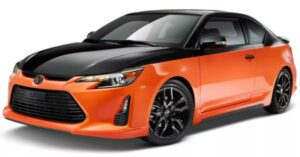 2027 Toyota Scion tC |
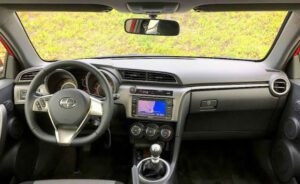 2027 Toyota Scion tC Interior |
2027 Scion tC gained popularity due to its low starting price, spacious interior, and extensive list of standard features, along with a wide range of accessories that allowed owners to personalize the vehicle to their liking. Although it handled well and offered the practicality of a hatchback, its substantial weight made it more of a comfortable daily driver than a high-performance sports car.
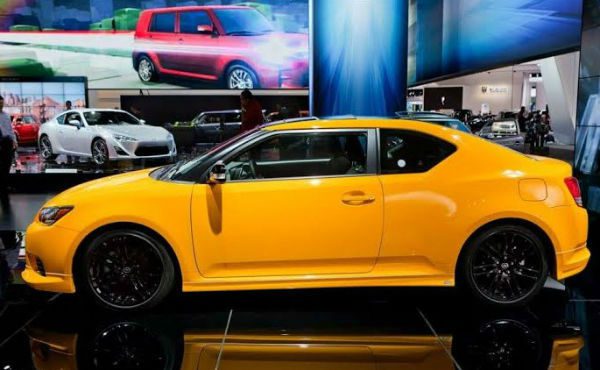
2027 Scion tC Car
As compared to the previous model, this generation offers superior highway passing power and acceleration, quick performance, while also improving fuel efficiency. Key competitors for the Scion tC included the Honda Civic Coupe, Hyundai Veloster, Kia Forte Koup, and Volkswagen Beetle. Depending on the model year, the initial price typically ranged between $16,000 and $22,000.
Scion tC Interior
The Scion tC features a driver-focused dashboard with a sporty aesthetic, combined with a design centered on functionality. Facing the driver, the dashboard houses large, clear gauges shielded by a glare-reducing hood; there is also a thick, leather-wrapped, flat-bottomed steering wheel, along with deep front seats featuring firm side bolsters that provide excellent support during spirited driving. The list of standard features was extensive relative to the price; highlights included a panoramic glass roof and high-quality Pioneer audio systems, which were later upgraded to touchscreen systems with Bluetooth connectivity in subsequent models. However, the interior design prioritized functionality over luxury, resulting in an aesthetic dominated by dark gray and black tones and extensive use of hard plastic, alongside noticeable wind and road noise during highway driving.
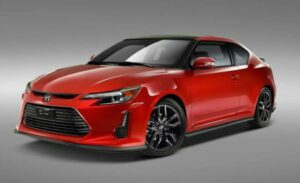 Toyota Scion tC 2027 |
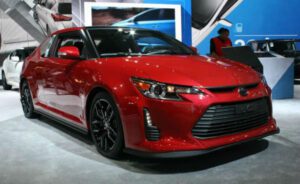 Scion tC 2027 |
A standout feature of the tC is its clever use of passenger and cargo space; it transcends the typical limitations of coupes thanks to its unique three-door liftback design. The interior comfortably accommodates up to five passengers, offering surprisingly generous rear legroom; furthermore, the rear seats can be reclined for added comfort. Although the low roofline limits headroom for taller passengers, the wide rear hatch makes loading the vehicle easy. When the split-folding rear seats (60/40 configuration) are folded completely flat, the cargo capacity increases significantly. This provides owners with ample cargo space—ranging from 34.5 to 35.4 cubic feet (approximately 977 to 1,002 liters)—capable of easily accommodating large items or multiple large suitcases.
Scion tC Engine
The first-generation Scion tC (2005–2010) is powered by a reliable 2.4-liter, inline-four 2AZ-FE engine, sourced directly from the Toyota Camry. This dual overhead cam (DOHC) engine produces 161 horsepower and 162 lb-ft of torque, utilizing Toyota’s Variable Valve Timing with intelligence (VVT-i) technology to deliver smooth, reliable power suitable for daily driving. Drivers could choose between a standard five-speed manual transmission and an optional four-speed automatic. For owners seeking greater performance, Toyota Racing Development (TRD) offered an official dealer-installed supercharger kit that boosted output to 200 horsepower and 185 lb-ft of torque. For the second-generation Scion tC, the car received significant mechanical upgrades, adopting a larger 2.5-liter inline-four 2AR-FE engine. This upgraded engine boosted output to 180 horsepower and 173 lb-ft of torque. To handle the increased power, Toyota replaced the older transmissions with highly efficient six-speed manual and six-speed automatic options.
Scion tC Safety
Scion tC established a strong safety record by enhancing protection levels across both generations. First-generation models earned an “Acceptable” rating from the Insurance Institute for Highway Safety (IIHS) and featured standard anti-lock braking systems (ABS) alongside front, side, and curtain airbags. Significant safety improvements were achieved with the second-generation redesign in 2011, which introduced Toyota’s Star Safety System technology. This system included standard features such as Vehicle Stability Control (VSC), Traction Control, and Smart Stop technology, while expanding the safety suite to include eight airbags, including knee airbags for the driver and front passenger. Thanks to these updates and a robust body structure, the second-generation tC received an “Overall Five-Star Safety Rating” from the National Highway Traffic Safety Administration (NHTSA) and was named a “Top Safety Pick” by the IIHS.