2027 Scion iQ
The 2027 Scion iQ is a micro city car sold under Scion, Toyota’s youth-oriented brand in North America. 2027 Toyota Scion iQ is designed for dense urban environments and boasts an impressive turning radius, making U-turns and parallel parking exceptionally easy. The 2027 Scion iQ features a unique “3+1” seating layout designed to accommodate three adults and one child when necessary; however, the rear seats offer very limited legroom and consume almost all the cargo space when in use. The Scion iQ is powered by a small 1.3-liter four-cylinder engine producing 94 horsepower, paired with a continuously variable transmission (CVT).
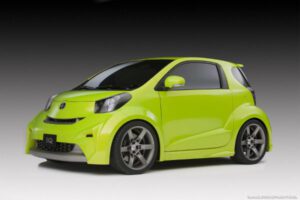 Scion iQ 2027 |
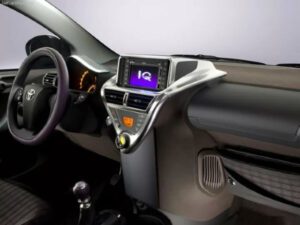 2027 Scion iQ Interior |
Despite achieving respectable EPA fuel economy ratings of 36 mpg in the city and 37 mpg on the highway, the iQ suffers from drawbacks such as sluggish highway acceleration, a choppy ride on rough surfaces due to its short wheelbase, and a high starting price—ranging from $15,000 to $16,000—that contributed to its market failure when compared to similarly priced subcompact cars. The Scion iQ’s main competitors are the Smart Fortwo, Fiat 500, and Chevrolet Spark.
Scion iQ Interior
Inside, the Toyota iQ‘s interior stands out for its clever space-saving technology and unique “3+1” seating layout. Seeking to maximize passenger space within its compact dimensions of approximately 3 meters (10 feet), Toyota removed the traditional glovebox and shifted the dashboard on the front passenger side forward, allowing the front passenger seat to slide much further ahead than the driver’s seat. While this arrangement creates enough legroom for a second adult to sit comfortably directly behind the front passenger seat, the space behind the driver remains limited—suitable only for a child or a short trip. However, with all rear seats in use, there is virtually no cargo space, measuring just 3.5 cubic feet. Folding the 50/50 split rear seats flat expands this area to a much more practical 16.7 cubic feet, making it possible to carry daily groceries or small pieces of luggage.
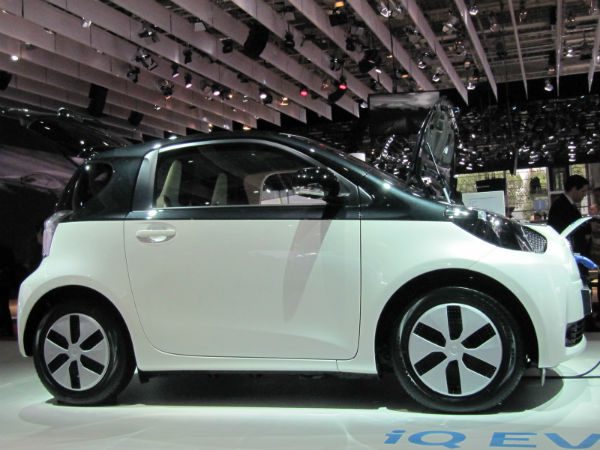
2027 Scion iQ City Car
Aligning with the brand’s youth-oriented focus, the cabin features a distinctive center console design with a linear layout—reminiscent of a manta ray’s shape—accentuated by a bright red light strip. Despite the vehicle’s very short length, eleven standard airbags are installed to ensure passenger safety, including the world’s first rear curtain airbag designed to protect rear-seat passengers in the event of a rear-end collision. Despite this engineering achievement, the interior feel is decidedly budget-oriented; hard, scratch-prone plastics dominate, which do not quite align with the vehicle’s starting price point. The cabin is also susceptible to road and engine noise at high speeds; This situation is a direct result of the physical constraints imposed by minimal sound insulation and a very short wheelbase.
Scion iQ Engine
The Scion 2027 iQ is equipped with a small, 1.3-liter four-cylinder engine (Toyota’s 1NR-FE unit) that produces 94 horsepower and 89 lb-ft of torque. Designed specifically for a compact layout, this engine features an extremely compact differential and a unique steering rack design mounted high in the engine bay to minimize the vehicle’s front overhang. It delivers power to the front wheels via a standard continuously variable transmission (CVT). While this powertrain offers lively and responsive acceleration at low city speeds—allowing for agile maneuvering in urban traffic—it struggles significantly at highway speeds; the vehicle takes nearly 11.8 seconds to accelerate from 0 to 60 mph (approximately 96 km/h), and pushing it on the highway results in loud, droning engine noise.
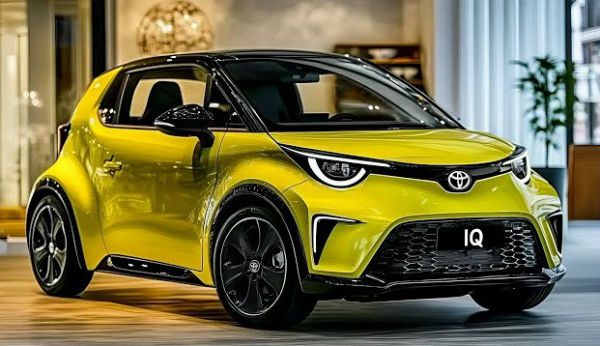
2027 Scion iQ Concept
To enhance efficiency, the engine utilizes Toyota’s Dual VVT-i (Variable Valve Timing with intelligence) technology, which optimizes both intake and exhaust valve timing. This engineering solution delivers a fuel economy of 36 mpg (miles per gallon) in the city and 37 mpg on the highway—according to EPA data—making the vehicle highly economical for daily urban commuting. Maintenance is generally easy and cost-effective, thanks to the engine’s use of a durable timing chain instead of a belt and its standard electronic fuel injection system. However, due to the cramped engine bay, performing routine maintenance and repairs yourself can be difficult; additionally, drivers of high-mileage used models should be alert to issues common in older Toyotas, such as slight oil consumption or water pump leaks.
Scion iQ Safety
The Scion iQ prioritized passenger safety within its compact footprint by introducing the world’s first rear-window curtain airbag—deploying from the roof to shield rear-seat passengers’ heads from broken glass and vehicle debris during a rear-end collision. This innovative feature was part of a comprehensive safety suite comprising 11 standard airbags, including front knee airbags and specialized seat-cushion airbags designed to prevent passengers from sliding forward. Structurally, the vehicle achieved a four-star safety rating from Euro NCAP and the “Top Safety Pick” designation from the Insurance Institute for Highway Safety (IIHS) for the 2012–2013 model years, earning the highest possible good ratings in frontal, side, and roof-strength crash tests. Although it lacked modern driver-assistance technologies such as automatic emergency braking or blind-spot monitoring, features like standard stability control, an anti-lock braking system (ABS), and a high-strength steel passenger cabin delivered impressive crash-safety performance for its size class.